Kiera Laney's Portfolio
The Full Story
Costa Rica Experience
I had the opportunity to go to Costa Rica with my soccer team during my spring break, my junior year. It was an amazing, eye-opening experience that I did not realize would impact me as much as it did. We had the opportunity to see the three parts of Costa Rica: city, rainforest, and beach. We also played soccer teams from each part, and it was such a unique experience! Check out the pictures below!
We first arrived at the Costa Rica airport and had a 5-hour bus ride to San Jose City. We had two tour guides who were from Costa Rica, and on the first day, they gave us an orientation presentation. Each slide went through the history of Costa Rica, including their independence, coffee boom, abolition of their army, and what their professional soccer teams look like here. They shared about Costa Rica’s history of colonization, as Costa Rica started in the 16th century as a Spanish colony. They did not have much gold or silver, and so they weren’t seen with much importance, leading to a strong neglect from Spain. So, they lacked products for the major overseas market and turned to a subsistence economy based on cacao and tobacco. This led to a growth of democratic ideals and has stuck with Costa Rican culture. They gained independence from Spain in 1821, which allowed them to focus on the coffee industry, which funded the architecture I saw in San Jose.
I thought it was really interesting because they said they have a very high success rate with school because they do not have a military. They were able to reallocate their funds that were originally used to fund the military towards healthcare, education, and other community purposes. They also told us in this presentation that they have a Top League of professional soccer and there are 12 teams in it. We were going to be playing three teams, but there is a large difference in skill level among them. We were able to ask questions at the end, and I had seen these pink trees over on the bus ride and outside our hotel, so I asked what they were. They were a pink trumpet tree, Tabebuia rosea, also known as "roble de sabana" or "pink poui". They were beautiful! They were all over because they thrive in hot, dry regions. After this presentation, I felt I had a foundation of what Costa Rica is all about!
We had our first game in San Jose City. We played Dimas FF, and we competed in a stadium that was fairly big. The first shock when we started playing was how technical and possession-based they were. We ended up winning, but at the end of the game, we were able to interact with them by having someone translate what they were saying. The whole team was so kind! Each team chose an MVP on the other team and took a picture together! There was an inherent mutual respect about giving each other awards, because it was deeper than just a competition. Some of them were as young as 15 or 16, and they expressed how grateful they were that they had the opportunity to play on an American team. Despite the language barrier, the love for soccer created a mutual ground for connection!
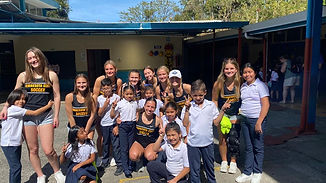
The next day was my favorite day. We went to an elementary school for underprivileged children. When we first walked into the school, I immediately wished I could give all the kids a hug. They had each created a welcome sign and little notes and performed a song for us as we sat in chairs. They had so much energy, and it felt so special. Then our team split into 5-6 groups, and the kids had a rotation between groups as we came up with little games at each station. My group decided to play “Pinnie Tag”. None of the children spoke English, so we showed them how to play by acting it out. We were super obvious with hand gestures to find a way around the language barriers. While our hand gestures helped bridge the gap and we were just playing games, it really hit me that being there as a student from a U.S. University carried an inherent weight of privilege. Giving out T-shirts and being the ones to organize their day made the wealth gap feel really real, which ties back to the colonial history that our guides presented to us. We knew some Spanish, so we asked if they had “preguntas” (questions), they were able to ask. It was so fun, and they were all so bright and happy. Throughout the game and while we visited their school, they would always run up and point to their eye and make a heart shape with their fingers. It was their way of saying “I love you”, and it was so special. At the end of our time with them, we gave them all T-shirts from our school. A little girl ran up to me and asked if she could get an extra shirt to bring to her mom. She used hand gestures and some Spanish words that I knew, so I could understand her. I grabbed her an extra and she was filled with joy! It shows that her immediate thought was to share something with her family, and not just keep it for herself. This reflects the type of culture she grew up in, always family first. As much as I was bonding with the children, the whole experience was so complex, as there was definitely a power dynamic where we were the visitors with all the resources and they were the ones who were receiving them. This experience was so special, and although there was a language barrier, our cultures relied heavily on gestures and expressions. Despite being “underprivileged children”, this did not dictate their happiness. They were so grateful, and it taught me that I need to be more grateful for the things that I have!
We then went to the National Stadium and took a tour of the San Jose Historic District. We walked around the main avenue- El Paseo Colón, visited Spain Park, saw the hospitals, and went inside Teatro Nacional. When we first walked into the stadium, it was so interesting. Our tour guides shared that the stadium is shaped like a coffee bean because it is known for its coffee and holds 35,000 people. I realized that the stadium being coffee bean shaped is more than just a design. It reflects the industry that built Costa Rica. As I talked about the colonization above, the coffee industry was everything to Costa Rica, especially as they were suffering with no money and no power. It fueled their economy, and it was beautiful to see it brought to life in the stadium. There was a lot of artwork along the walls of the stadium. There was a picture with a mask on one side, and the other side signifies the Costa Rican culture. It was really powerful. After our tour, we went back and had a late lunch. Most of our lunches consisted of fresh beans and rice, along with chicken. That is the most common cultural food in Costa Rica, and it was so good.
That night, we had our second game against LDA FF. It was at a new stadium, and it was much different than the last one. It was more of a complex, but the buildings were a lot more modern. I was curious as to why it was so different than the previous team’s conditions, and our tour guide said that some teams are very well funded. They tend to get to pay their players more, which causes a larger discrepancy between the teams in the league, because some players don’t get paid at all. This game was a close game, and this team was very skilled. They were top of their league, but we did end up winning. We did the same tradition after the game and it was really special. Despite the language barrier between us, I started to observe how language can reflect a deeper meaning about cultural status. This team was much more established and clearly better funded. They spoke more English than the previous team, which made it easier to connect. Their language skills were not just for communication, but also a symbol of their status. However, the reliance on Spanish (the native language) and our use of English highlighted the power dynamic where English speakers often set the terms for international communication.
The next day, we transferred to our rainforest excursion. We had the opportunity to go white water rafting, and it was such a cool experience. We saw all different kinds of animals like white-faced monkeys, falcons, and a sloth! We had time to talk to our instructor while we were in calm waters, and we asked about his life. He said he chose this career instead of soccer because the pay and opportunities in Costa Rica weren’t very good. As I reflected later, this showed me that Costa Rica’s economy relies on their natural beauty. The tourism industry offers higher pay, in comparison to choosing a professional sports path. He also talked about all the different animals and it was really interesting to learn more about their nature.
We then traveled to the Arenal Volcano, which is dormant but still steams a little. I loved seeing Costa Rica’s beautiful nature on the drive through the rainforest. There is so much green, and it just grows wildly. In Costa Rican culture, they prioritize conservation and avoid trying to control nature, and I think that’s beautiful. I also noticed on our long bus rides, as I looked out the window, how many wild horses and cows there were. Seeing these animals, it speaks to the roots of Costa Rica, outside of the tourist hub. While we were in the rainforest part of Costa Rica, we went and saw La Fortuna Waterfall. It was 500 steps to get to the waterfall, and it was breathtaking. It was so cool to be able to walk on the steps through the rainforest and see all the natural plants that grow, and as I said before, it truly speaks to Costa Rica’s core values of conservation. A fun fact that our tour guides told us on the steps was that Costa Rica holds 5% of the world’s total species. This further justifies its biodiversity.
Later that day, we had our last game. We played against San Carlos FF. This was the most special game of all. When we arrived, it was a grass field in the middle of a neighborhood and had two locker rooms. This was much different from the previous fields we had played at. This field contrasted heavily with the facilities that we had seen before, representing a clear power dynamic of how investments of each team are distributed. It felt like all the money would go to the top teams in the league, leaving a large gap between teams in the league, where some players don’t get paid at all. Before the game, both teams lined up, and they played our national anthem and Costa Rica’s national anthem. We then shook hands with all the players. Throughout the game, people would show up around the fence, and many neighbors came out of their houses to watch. After the game, we conversed with this team a lot, as some of the girls knew English. Everyone was so giggly and so kind. We went over by the locker rooms, and we found that people from the neighborhoods had brought and cut fresh fruit for all of us to enjoy. It was so special, and I really felt like I got to know their culture. It showed me how important community, respect, and hospitality are in Costa Rica. This game was a way of coming together, and it truly made it unforgettable.
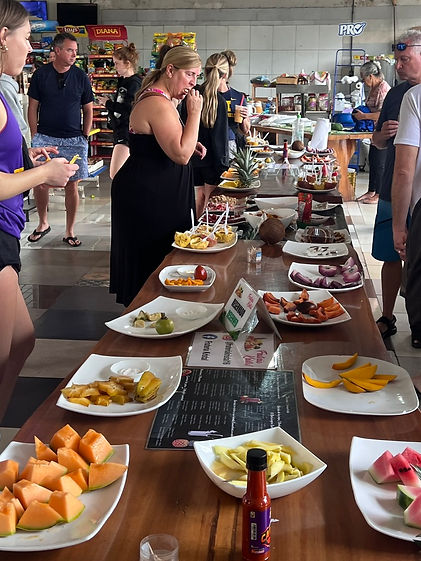
We then ended the trip by traveling to the beach. On our way, we stopped at this small market that had all kinds of fruit to try. Most of the fruit I had never tried, and pejibaye was definitely not my favorite! But the best one was caimeto. Seeing street markets gave a sense of a slower and more relaxed pace of life in Costa Rica. There were so many locals that just had small little pop ups on the side of the road. I feel like here, in Minnesota, everything is a rush and getting to one place after another. It truly reflects the common saying our tourists kept saying, “Pura Vida!” meaning simple life.
As I reflect back on the trip as a whole, I see “Pura Vida” shining through. Every local that we interacted with was so happy and content with where they were at. Whether they were the instructor guiding us down the river or the young children at the school, they all had smiles, carried with warmth and positivity. I am so grateful for this experience and wouldn’t change it for the world!
Now, as I look forward into my future, I am excited to look at culture in a new light. Culture is not something that you just learn in a classroom; you have to experience it. It is in the everyday moments and observing the traditions. Seeing how deeply values like community, kindness, and gratitude are prioritized in Costa Rican culture, motivates me to be more open-minded and understand the core values of my culture, too. As I continue to experience new cultures, I want to approach with curiosity and respect, taking the time to understand perspectives, rather than creating my own assumptions. No matter where I go, this experience has inspired me greatly!